
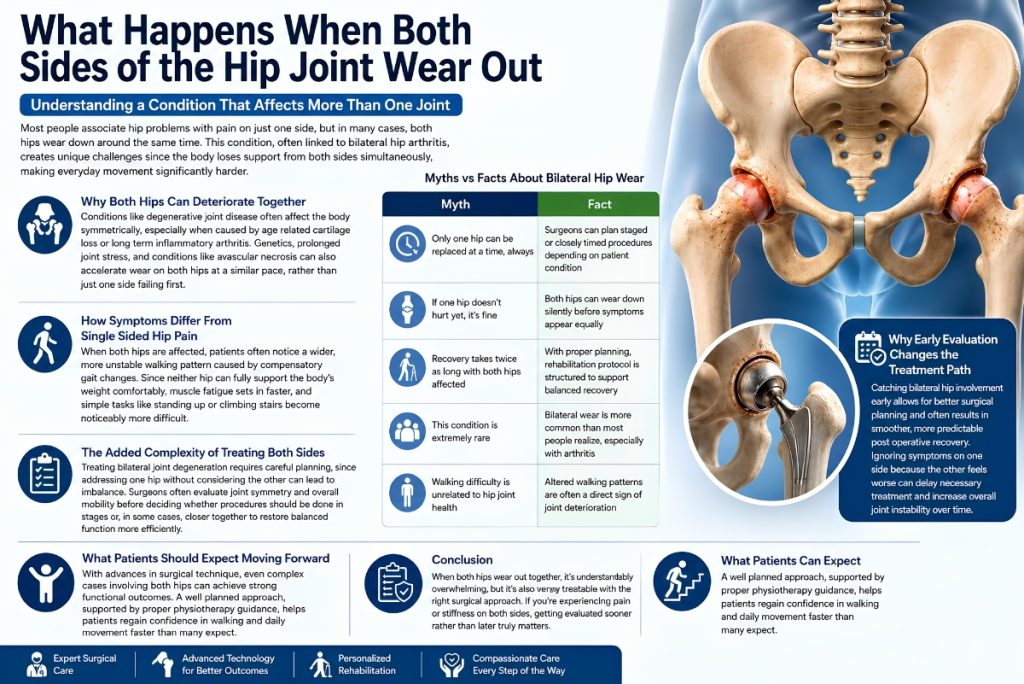
Understanding a Condition That Affects More Than One Joint
Most people associate hip problems with pain on just one side, but in many cases, both hips wear down around the same time. This condition, often linked to bilateral hip arthritis, creates unique challenges since the body loses support from both sides simultaneously, making everyday movement significantly harder.
Why Both Hips Can Deteriorate Together
Conditions like degenerative joint disease often affect the body symmetrically, especially when caused by age related cartilage loss or long term inflammatory arthritis. Genetics, prolonged joint stress, and conditions like avascular necrosis can also accelerate wear on both hips at a similar pace, rather than just one side failing first.
How Symptoms Differ From Single Sided Hip Pain
When both hips are affected, patients often notice a wider, more unstable walking pattern caused by compensatory gait changes. Since neither hip can fully support the body’s weight comfortably, muscle fatigue sets in faster, and simple tasks like standing up or climbing stairs become noticeably more difficult.
The Added Complexity of Treating Both Sides
Treating bilateral joint degeneration requires careful planning, since addressing one hip without considering the other can lead to imbalance. Surgeons often evaluate joint symmetry and overall mobility before deciding whether procedures should be done in stages or, in some cases, closer together to restore balanced function more efficiently.
Myths vs Facts About Bilateral Hip Wear
Myth | Fact |
Only one hip can be replaced at a time, always | Surgeons can plan staged or closely timed procedures depending on patient condition |
If one hip doesn’t hurt yet, it’s fine | Both hips can wear down silently before symptoms appear equally |
Recovery takes twice as long with both hips affected | With proper planning, rehabilitation protocol is structured to support balanced recovery |
This condition is extremely rare | Bilateral wear is more common than most people realize, especially with arthritis |
Walking difficulty is unrelated to hip joint health | Altered walking patterns are often a direct sign of joint deterioration |
Why Early Evaluation Changes the Treatment Path
Catching bilateral hip involvement early allows for better surgical planning and often results in smoother, more predictable post operative recovery. Ignoring symptoms on one side because the other feels worse can delay necessary treatment and increase overall joint instability over time.
What Patients Should Expect Moving Forward
With advances in surgical technique, even complex cases involving both hips can achieve strong functional outcomes. A well planned approach, supported by proper physiotherapy guidance, helps patients regain confidence in walking and daily movement faster than many expect.
Conclusion
When both hips wear out together, it’s understandably overwhelming, but it’s also very treatable with the right surgical approach. If you’re experiencing pain or stiffness on both sides, getting evaluated sooner rather than later truly matters. Consulting an expert in Total Hip Replacement Surgery in Ahmedabad can help you understand your exact condition and treatment options. At Saviour Hospital, Dr. Rushay Bhalodia brings extensive experience managing complex hip conditions, helping patients on both sides regain stability, mobility, and a better quality of life.