
Introduction
Hip pain can gradually affect walking, climbing stairs, sitting, and other everyday activities. When joint damage becomes severe and non-surgical treatments no longer provide enough relief, hip replacement may be considered. Depending on the condition of the joint and the reason for surgery, a doctor may recommend either total or partial hip replacement. Understanding how these procedures differ can help patients have a more informed discussion with their orthopedic specialist.
Understanding the Hip Joint
The hip is a ball-and-socket joint that connects the thighbone to the pelvis. The rounded top of the thighbone, called the femoral head, fits into a socket called the acetabulum. Smooth cartilage covers these surfaces and helps the joint move comfortably.
Conditions such as advanced arthritis, certain fractures, or other forms of joint damage can affect these structures. The extent and location of this damage are important when determining which type of surgery may be appropriate.
What Happens During Total Hip Replacement?
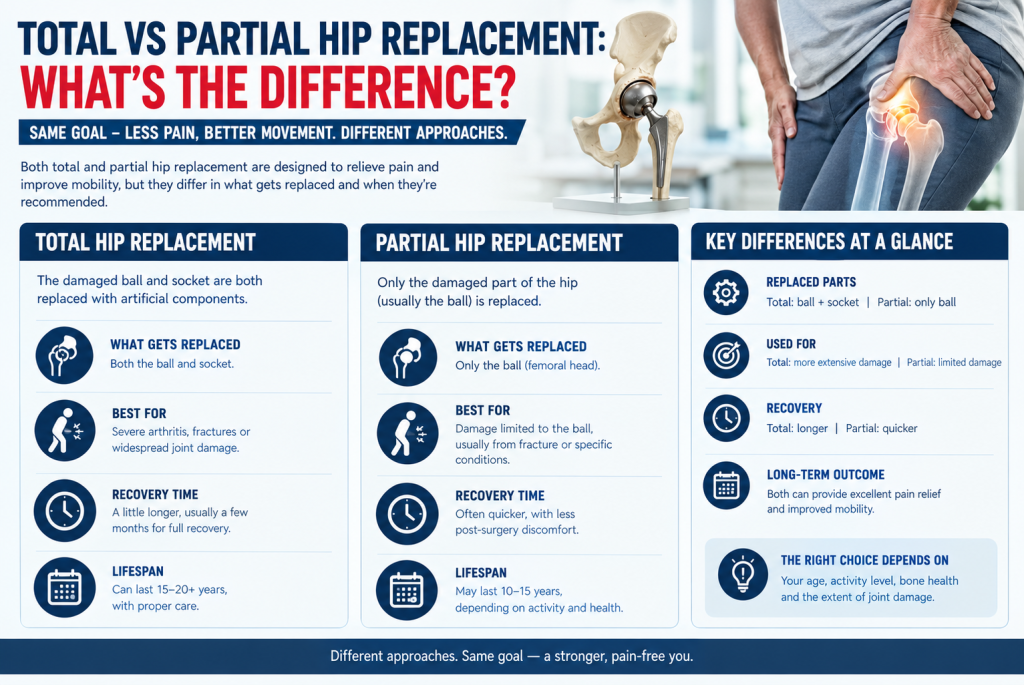
Total hip replacement involves replacing both major damaged parts of the hip joint. The damaged femoral head is removed and replaced with an artificial ball, while the damaged surface of the acetabulum is replaced with an artificial socket.
This procedure may be considered when there is significant damage affecting the joint, such as advanced osteoarthritis or other conditions causing substantial pain and loss of function.
The goal is to remove the damaged joint surfaces and restore smoother movement, while also helping reduce pain and improve mobility.
What Is Partial Hip Replacement?
Partial hip replacement generally involves replacing the damaged femoral head while leaving the natural acetabular socket in place. It is commonly considered in selected patients, particularly for certain types of hip fractures.
Because the socket is not replaced, the procedure may be suitable when the acetabulum remains in reasonable condition. However, the decision depends on several factors, including the cause of the hip problem, bone quality, age, activity level, and overall health.
Total and Partial Hip Replacement: Key Differences
The main difference is the amount of the hip joint that is replaced.
With total hip replacement, both the ball and socket are replaced with artificial components. With partial hip replacement, primarily the ball is replaced while the natural socket remains.
The reason for surgery also differs. Total replacement is often used when disease or damage affects multiple surfaces of the hip, while partial replacement may be selected for specific conditions where the socket does not require replacement.
The surgical approach, recovery experience, and rehabilitation requirements can also vary between individuals. Therefore, the procedure should be selected according to the patient’s specific clinical situation rather than based on a single factor such as age.
How Do Doctors Decide Which Procedure Is Suitable?
Choosing between total hip replacement and partial hip replacement requires an individual assessment. An orthopedic specialist may review the patient’s symptoms, medical history, physical examination, X-rays, and other imaging when necessary.
The cause and extent of joint damage are particularly important. Doctors may also consider bone quality, mobility, activity requirements, other health conditions, and the expected demands on the new joint.
A detailed evaluation helps the surgical team determine which option is more appropriate for the individual patient.
Choosing the Right Joint Replacement Hospital
When considering surgery, choosing an appropriate joint replacement hospital is also an important part of the process. Patients can consider the experience of the orthopedic team, diagnostic facilities, surgical support, physiotherapy services, infection-control practices, and postoperative follow-up.
It is also useful to discuss the expected benefits, potential risks, recovery process, and available alternatives with the treating specialist before making a decision.
Making an Informed Decision
Total and partial hip replacement are different procedures designed for different clinical situations. Total hip replacement replaces both major joint surfaces, while partial hip replacement generally replaces the femoral head alone.
The most suitable option depends on the condition of the hip, the reason surgery is being considered, and the patient’s individual health and functional needs. A consultation with an orthopedic specialist can help determine which treatment approach is appropriate.